See external risk before it lands on your register.

Named exposure with severity, velocity and evidence attached, scanned across your horizon every day and reported on your cadence.

See an instant demoSee the horizon scan

See which risks are actually building.

A three-day blip and an eleven-month build look identical on day one. Our horizon scan reads the shape: what is chronic, what is emerging, and what is just noise.

Horizon scan · 12 months back, 90 days forward Bar length is duration; colour is trajectory. Click a theme to open why it did, or did not, build.
Chronic · building Recurring · emerging Contained · fizzled Checkpoint Polecat flag Next 90 days
AUG SEP OCT NOV DEC 25 JAN 26 FEB MAR APR MAY JUN JUL AUG SEP OCT NOW
▸ Affordability CHRONIC
61% →
▸ Product safety RECURRING
44% →
▸ Kid safety EMERGING
26% →
▸ Geopolitical DORMANT
15% →
▸ Store incidents NO PATTERN
▸ Hygiene scare CONTAINED
▸ Local siting FIZZLED
▸ Price gripes FIZZLED

See where a risk is heading, not just where it has been.

Most tools tell you what already happened. Polecat compares live events against two decades of resolved risk events to project where it is likely to travel next.

  • Early warning before an issue becomes a crisis.
  • Time to impact and expected recovery, quantified.
  • Peer comparison against how comparable events moved.
See a live trajectory

We learn the shape of a risk

Risk: Supply chain
1 Learn the shape
2 Compare peers
3 Measure & project
Early warning
Time to impact
Severity
Recovery curve
Learned across hundreds of events
Peers in sector Peer A Peer B Peer C
Your live event
TODAY
Projected trajectory

Learn the shape. Across hundreds of past supply-chain events we log early warning, time to impact, severity and how reputation recovers.

Compare peers. We overlay how comparable companies in your sector moved through the same kind of event.

Measure and project. We measure your live event against that history and project where it is likely to travel next.

Track the risks you care about.

News, social and fringe channels scanned in real time against your taxonomy, your definitions and your thresholds.
Key Posting Alerts Individual postings routed to the right team the moment they clear a severity threshold.
Daily Risk Briefings What changed in the last 24 hours and why it matters, tailored to how you frame your world of risk.
Executive News Briefs The themes and key risks that should be escalated to management for awareness. Themes, not headlines.
Horizon scan · live alerts
Monitoring
Drop the early-alerts / horizon-scan screenshot here

One risk engine, many ways to report.

Choose how your team steps back and reports. Every deliverable runs on the same live, outside-in view, aggregated and projected forward for your reporting cycle.
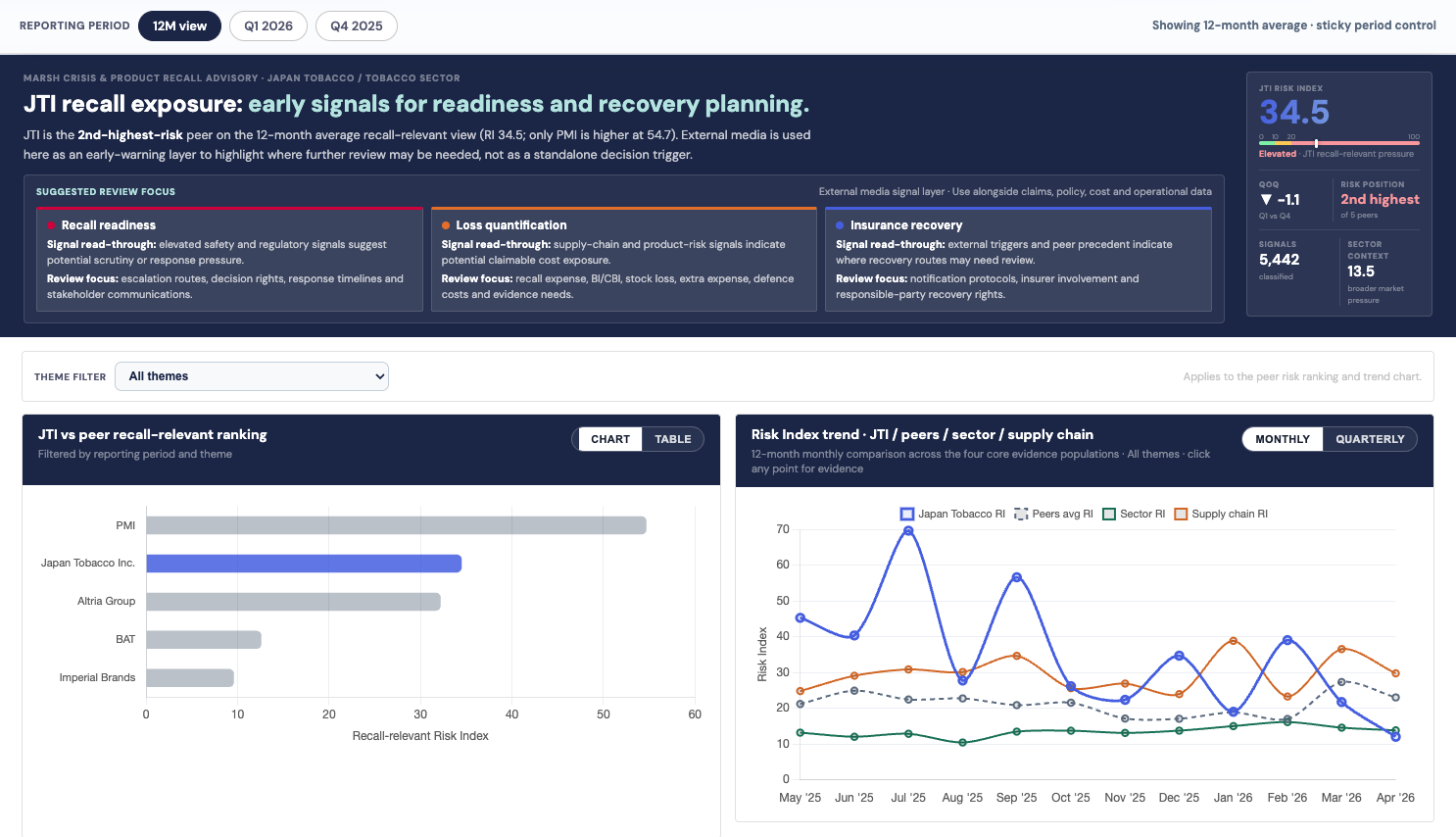
See everything on one live screen.

Total exposure, open events and risk by category, quantified and updating as events move. Track where you sit against your own baseline, drill into any category, and share the same live view with your team and your risk committee.

See instant demo
Live dashboards
A day in the life

One risk desk. One working day.

See how you can use Polecat during your every day.

Wednesday 28 Today
Detect Report
08
09
10
11
12
13
14
15
16
17
18
Alerts over coffee Threshold alerts
The Daily Risk Briefing 24-hour change
Risk stand-up Team · risk landscape
A board question Ask the platform
Committee prep Peer benchmark · scenarios
No analyst backlog End of day
08:45
Layer 1 · KPAs
08:30 – 09:00

Alerts over coffee

Overnight postings that cleared threshold, one flagged red for a Tier 1 supplier. Two minutes, before the inbox.

Layer 1, Detect
Auto-playing the day, hover or tap to take control

A two-layer operating model for external risk.

Layer one detects and alerts every day. Layer two aggregates and reports on your cadence. One quantification engine underneath both.

Layer 1 · Every day

Detect & alert

Horizon scanning across news, social and fringe, scored in real time against your own taxonomy.

Key Posting AlertsThe moment a threshold is cleared
Daily Risk BriefingsWhat changed in 24 hours
Executive News BriefsThemes to escalate, weekly
aggregates & projects forward
Layer 2 · Monthly or quarterly

Aggregate & report

Step back from the daily flow: what actually moved, and where the next two quarters point.

Live dashboardsExposure on one screen
The platformA workspace you log into
Board reportsCommittee-ready packs
One quantification engine The same live, outside-in view under both layers
1.4M+Premium sources 195Countries 20 yearsResolved risk events
25%

of documented risks at Wendy’s are first surfaced through Polecat’s horizon scanning, before they appear anywhere else on the register.

“We hoover up every signal, social chatter, regulator memos, and think-tank white-papers, because you cannot model what you cannot see. Polecat handles the volume so my analysts are not trapped in spreadsheets.”

Bob Bowman · Chief Risk Officer, Wendy’s

Questions from risk and compliance leaders

Horizon scanning is the systematic search for emerging risks before they are visible in a company’s own data or register. Polecat scans more than 1.4 million premium sources across 195 countries every day, including news, regulators, NGOs, academia, think tanks and social channels, scores each event against a client’s own risk taxonomy and thresholds, and routes named exposure to the responsible team with severity and velocity attached. Alerts run daily; aggregation and projection run monthly or quarterly. How Polecat works

Polecat is calibrated to a client’s own taxonomy, definitions and thresholds at set-up, so external risk is scored in the same categories and language the register already uses. Scores are delivered in a format that drops into the register alongside internal controls data, through an API into GRC platforms, through MCP, or as briefings and dashboards. Nothing in the register needs to be restructured; Polecat adds the measured external view to each risk that already exists and surfaces the ones that do not yet.

Yes. Every Polecat score is traceable to the source events behind it, each of which is scored on severity, velocity, sentiment, authority, reach and history against two decades of comparable, resolved events. The method is consistent across time and across peers, so a score of 68 out of 100 means the same thing in any quarter and for any company. When a board member, auditor or regulator asks how a conclusion was reached, the evidence trail answers the question.

Polecat projects each live risk three to six months forward, with base, best and worst case scenarios and the probability of each. The projection compares the shape of the live event, including its early warning, velocity and severity, with two decades of resolved risk events in the same sector, which shows how comparable events typically developed, how long they took to reach impact and how long recovery took. The projection updates as new evidence arrives. How Polecat works

No. Polecat is the judgement layer that sits on top of listening and monitoring tools, rather than a replacement for them. Monitoring tools collect and count; Polecat scores, benchmarks and projects, and tells the team which of the items collected are building into risk. Most clients keep their existing tools for coverage and use Polecat to decide what matters, what to escalate and what to report.

Polecat classifies each theme by pattern over time, as chronic, recurring, emerging, contained, fizzled or dormant, by comparing its momentum with how similar themes behaved in the archive. On day one a three-day blip and an eleven-month build look identical; by comparing the live event’s shape with resolved events, Polecat shows which it is likely to be and why. The horizon scan view lets a team open any theme to see the evidence behind its classification.

The two-layer model is how Polecat is run inside a client. Layer one, detect and alert, runs every day: horizon scanning across news, social and fringe sources, scored against the client’s taxonomy, with alerts routed to the right team. Layer two, aggregate and report, runs monthly or quarterly: the daily flow is aggregated into themes, trajectories and scenarios for risk committees and the board. Both layers run on one quantification engine, so the alert and the board report are consistent.

Each day a risk team receives key posting alerts, which route individual items to the responsible owner once they clear a severity threshold, and a daily risk briefing that sets out what changed in the last 24 hours and why it matters. Executive news briefs summarise themes and key risks for escalation to management, organised by theme rather than by individual item. Live dashboards show everything building across the horizon on one screen.

Yes. Polecat delivers scored external risk through an API into GRC and integrated risk management platforms, so external exposure sits next to internal controls, incidents and assessments in the system a risk team already uses. Polecat also provides MCP access for AI assistants such as Microsoft Copilot and Claude, and direct platform access through RepVault and PolecatX. Integration is scoped during set-up against the client’s platform and taxonomy. How we work with partners

A GRC platform records and manages risks a company already knows about; a consultancy provides periodic expert opinion. Polecat provides the continuous, quantified external data that both of them lack: live detection of emerging risk, scoring against two decades of history, peer benchmarking and forward projection, with the evidence trail attached. Polecat’s sector analysts interpret the output. Many clients run Polecat into their GRC platform and share the output with their advisers.

The Risk Intelligence Audit is a fixed-scope, three-week engagement priced at £25,000 that stands up both layers of the operating model for a client. It calibrates Polecat to the client’s taxonomy and thresholds, backfills the historical baseline, benchmarks current exposure against peers, and delivers the first live dashboard, daily alerts and an initial board-ready report. It is the usual starting point for a continuous engagement and can be scoped to a single business unit or risk category. Talk to our team

Both. Compliance teams use Polecat to track regulatory movement in every jurisdiction that applies to them, from consultation to enforcement, and to evidence that emerging obligations were identified and assessed in time. Because every score is dated and source-traceable, the output supports regulatory reporting, audit trails and board attestations. Polecat does not provide legal advice; it provides the measured external evidence that compliance decisions and documentation draw on.

Stand up both layers in three weeks.

A fixed-scope £25K Risk Intelligence Audit of the risks moving fastest on your register, benchmarked against your peers. It is how most risk and compliance teams start with Polecat.

Try the instant demo Talk to our risk team