Know what is shaping perception of your organisation, and where you can shape it.

Polecat measures how narratives about your organisation and your industry are developing across news, research, investor and NGO sources, benchmarked against your peers and two decades of comparable data. Your team sees where to lead, where to respond and where to hold back, with the evidence behind each recommendation.

How we help your day to day

Not every narrative needs a response. Some are an opportunity to lead.

Media monitoring shows what is being reported. A narrative rarely starts there. It takes shape among unions and employee groups, academics and think tanks, regulators, investors and NGOs. Polecat scores each of these voices on the same basis and compares them with your peers and two decades of history, so your team can see who is driving a narrative, which audiences it is reaching and where no one has yet set the terms. That is the basis for deciding where to lead, where to respond and where to hold back.

Narrative triage · what to answer, what to leave Each narrative is scored on prominence, momentum and audience influence, then read against your exposure. Click any row for the evidence behind the call.
▸ Automation is the next offshoring
Engage now
The fastest-building frame in the set, and the evidence field is empty. Whoever publishes headcount and investment figures first sets the terms.
▸ Where did the jobs go
Engage now
Every closure is a named, dated grievance, and every answer is already a public figure.
▸ Margin, not competitiveness
Prepare
Runs on your own disclosure calendar. Pre-brief every results day and hold the counter-example ready.
▸ The wage benchmark
Prepare
A competitor settlement becomes the public number the day it lands. Prepare the comparison before it is set for you.
▸ Suppliers speak for you
Prepare
You get named in disputes you are not party to. Agree in writing who speaks when a supplier is struck.
▸ Workers pay for the transition
Monitor
Dormant since June. The next capacity decision reactivates it. Have the transition evidence ready for that day.
▸ An industry at war with itself
Do not engage
Every employer intervention in this dataset produced coverage favourable to the other side. Holding line only.
▸ Every move is a political proxy
Do not engage
Set the response policy before it is tested: one spokesperson, no improvisation at the gates.
Illustrative. Built on 1,413 media events and 722 social posts from a live client assessment.

Follow the issues and stakeholders that matter to you.

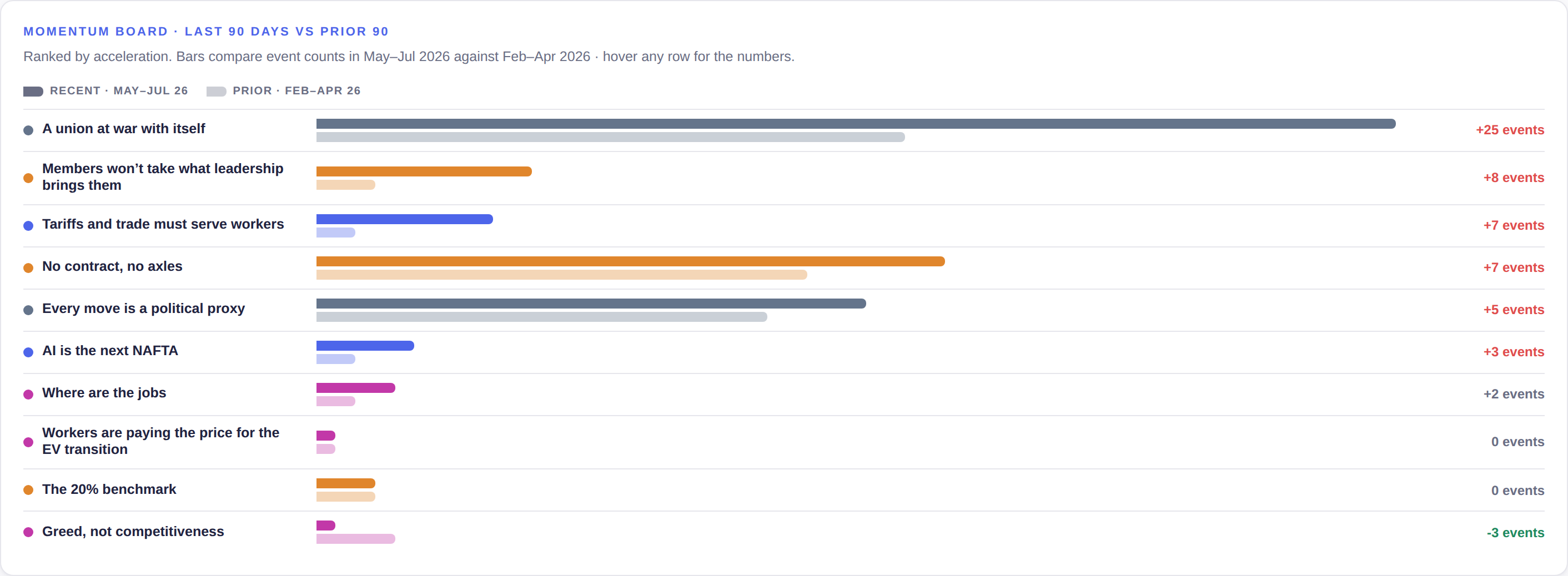
Polecat assesses news, policy, regulatory, research, investor, NGO and industry sources each day against your issues, your terminology and your priorities. Change is measured rather than estimated: the last 90 days against the prior 90, reach assessed separately from volume, and movement tracked as a narrative reaches new audiences.
Priority Alerts Sent to the right person when a development reaches the level of significance you set.
Daily Narrative Briefings What changed in the last 24 hours and why it matters, framed the way your issues register frames it.
Executive Comms Briefs The themes leadership should be aware of, and the opportunities worth pursuing, before anyone asks.
Narrative momentum · last 90 days vs prior 90
Measured
Momentum board, last 90 days against the prior 90

One view of your reputation, reported the way your organisation works.

Choose how your team reviews and reports. Every deliverable draws on the same outside-in data, assessed for your reporting cycle.
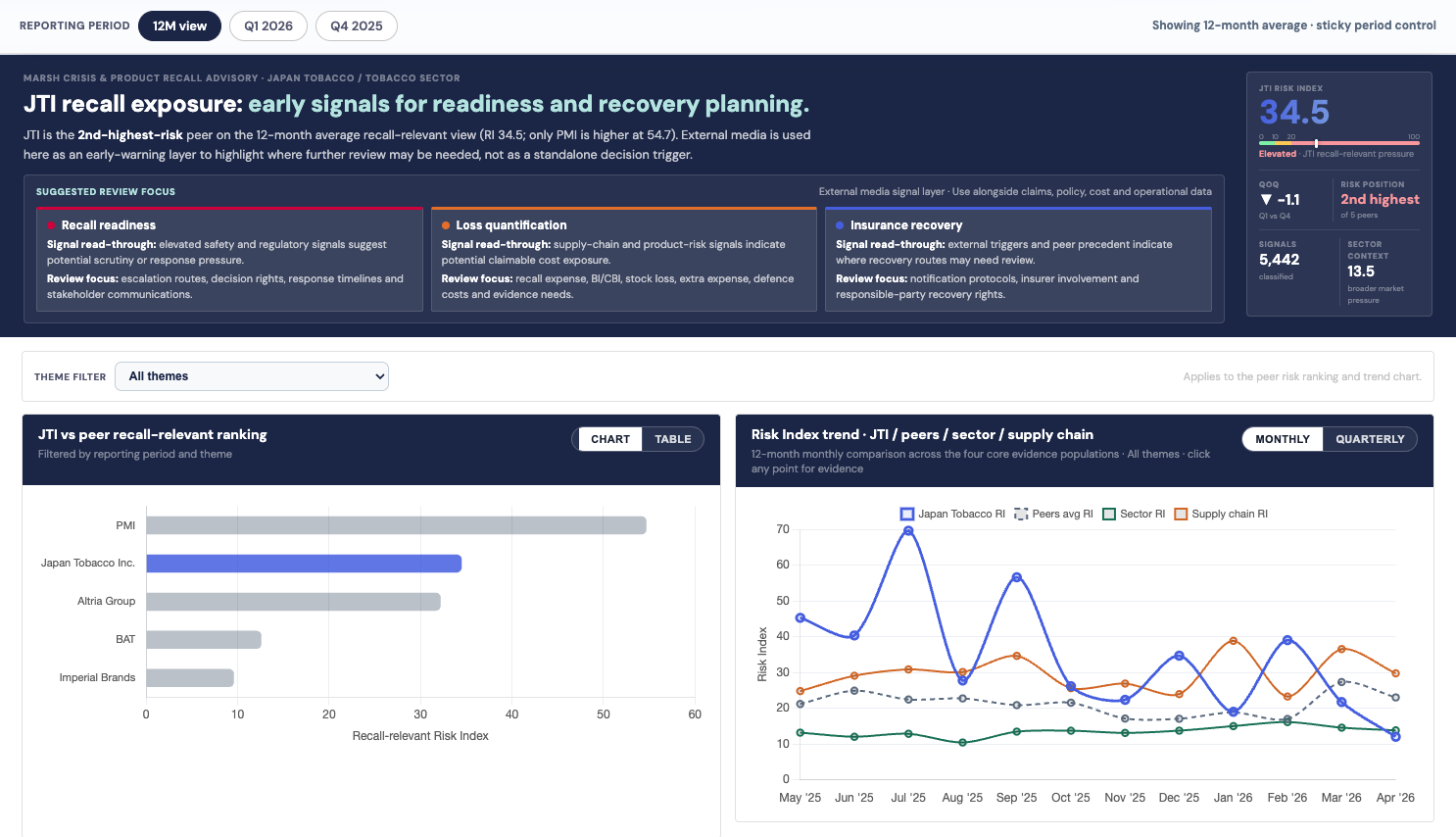
Your position on one live screen.

Overall exposure, active narratives and reputation by driver, quantified and updated as events develop. Compare your position with your own baseline and with your peers, review any narrative in detail, and share the same view with your team and executive committee.

See an instant demo
Live dashboards

One communications team. One working day.

How Polecat supports the decisions made across a typical day.

Wednesday 28 Today
08:15 – 08:45 · Layer 1 · Alerts

Overnight postings that cleared threshold, one flagged red on a claim spreading into a new audience. Two minutes, before the inbox.

09:00 – 09:45 · Layer 1 · Daily brief

What changed in the last 24 hours and why it matters, organised around your own issues and priorities.

10:30 – 11:10 · Layer 1 · Team

The narrative board on the screen: what is building, what is fading, and where the team should spend the day.

11:30 – 12:10 · Layer 1 · Platform

A hard question on a contested figure. Ask the platform in plain language and get a cited answer back in seconds.

13:00 – 13:40 · Layer 1 · Detect

Before committing to a campaign, the team checks which themes are gaining attention, where peers have already taken a position, and where no one has yet set the terms.

15:00 – 15:40 · Layer 1 · Triage

Prominence, momentum and audience influence, read against your exposure. Engage now, prepare, monitor, or hold the line.

16:30 – 17:20 · Layer 2 · Report

Next week’s executive committee: peer benchmark and forward scenarios pulled straight into the pack.

18:00 – 18:30 · Layer 2 · Report

No waiting on a clippings round-up. The same insight on every desk, at every level of the team.

A two-layer operating model for reputation.

Layer one identifies and prioritises every day. Layer two assesses and reports on your cadence. The same quantified data sits beneath both.

Identify and prioritise

Horizon scanning across your issues, stakeholders and peers, assessed daily against the narratives you track and the positions you want to build.

Priority AlertsWhen a development needs attention
Daily Narrative BriefingsWhat changed in 24 hours
Executive Comms BriefsThemes and opportunities to escalate, weekly
aggregates and assesses

Assess and report

A considered review of which narratives moved, which stakeholders are driving them, how your position compares with peers, and where the opportunities are.

Live dashboardsYour position on one screen
Narrative assessmentsThe full landscape, evidenced
Board & ExCo reportsCommittee-ready packs
The same outside-in data beneath both layers
1.4M+Premium sources 195Countries 20 yearsScored, comparable data

Questions from communications and corporate affairs leaders

Narrative intelligence is the measurement of the narratives forming around an organisation and its industry: which are building, who is driving them, how they compare with peers and where a company can lead, respond or hold. Media monitoring reports what has been published; Polecat quantifies the narratives behind it, tracks their momentum and identifies the stakeholders carrying them. Most communications teams run Polecat alongside their existing monitoring, as the layer that decides what matters. How Polecat works

Many narratives start with unions, academics, regulators, investors, think tanks and NGOs long before a journalist writes about them. Polecat scores these voices consistently across more than 1.4 million premium sources, weighting each for authority and reach rather than volume, and compares the result with peers. A frame that is building fast with little evidence behind it, or a grievance that is accumulating site by site, is visible to the communications team while there is still time to shape it.

Polecat scores each narrative on prominence, rate of change and the influence of the voices carrying it, then assesses it against the organisation’s own exposure and the positions of its peers. The result is a posture for each narrative: engage now, prepare, monitor or do not engage, with the evidence behind each recommendation. A narrative that is building fast with no evidence yet is usually an opportunity to lead; one that is dormant but could be reactivated by a decision is one to prepare for.

Yes. Polecat shows where attention is growing, where peers are absent or exposed, and where audiences differ by market or stakeholder group, which is the basis for campaigns, positioning and thought leadership. A narrative that no competitor has yet claimed, or a theme in which a client’s record is stronger than the sector’s, is flagged as an opportunity to lead rather than as a risk to manage. The same scoring applies to both.

Polecat measures reputation as a scored, comparable series rather than a snapshot. Movement is assessed as the last 90 days against the prior 90, with reach measured separately from volume, so a narrative that is spreading among influential audiences is distinguished from one that is merely loud. Each narrative is tracked against the client’s own issues, terminology and priorities, and benchmarked against peers, which separates a lasting shift from a temporary spike.

Yes. Polecat scores a client and a chosen peer set on the same basis, so a communications team can see which narratives are specific to the company and which are shared by the sector, where a competitor is more exposed, and where the client holds the stronger position. Peer benchmarking is built into every narrative assessment and every dashboard, and the peer set can be changed as the competitive landscape changes.

Social channels are among the sources Polecat covers, but Polecat is not a social media monitoring tool and does not measure hashtag reach or follower counts. Polecat analyses conversations and outcomes across news, research, regulatory, investor, NGO and social sources together, scoring each for authority and reach as well as volume. This gives a communications team a measured view of which narratives are reaching the audiences that matter, rather than a count of posts.

Each day a communications team receives priority alerts, routed to the right person when a narrative or stakeholder clears a threshold, and a daily narrative briefing on what moved in the last 24 hours and why it matters. Executive communications briefs summarise themes for leadership. Live dashboards show the organisation’s position on one screen, and narrative assessments and board reports are produced on the client’s cadence. Every format runs on the same scored view.

Yes. Agencies work from the same shared view as the in-house team, with the same scores, evidence and narrative postures, so briefings, responses and campaign planning rest on one set of facts. Access can be scoped to the issues and markets an agency handles. Several Polecat clients use the shared view as the basis for their agency’s monthly reporting, which removes the need to reconcile different monitoring outputs.

Yes. Every narrative score traces back to the source events behind it, each scored consistently for prominence, rate of change, authority and reach. Board reports present reputation as a measured series benchmarked against peers, with the drivers of any movement identified, so a board can see whether a shift is lasting or temporary and what caused it. When a director asks how a conclusion was reached, the evidence trail answers the question.

Polecat’s analysis draws on two decades of scored, comparable data on how narratives have formed, spread and resolved across sectors and companies. That history is what separates a lasting shift from a temporary spike: a live narrative is compared with how similar narratives behaved for comparable organisations, which supports the posture recommended for each. New clients are backfilled against the archive so the baseline is in place from the first briefing.

The Narrative Intelligence Assessment is a fixed-scope, three-week engagement that identifies the narratives moving fastest around a client, the stakeholders driving them, and how the client’s position compares with its peers. It delivers a posture for each narrative, lead, respond, prepare or hold, with the evidence behind it, together with the first live dashboard and daily briefing. It is the usual starting point for a continuous engagement with a communications or corporate affairs team. Talk to our team

Know which narratives to lead, answer or leave, in three weeks.

A fixed-scope Narrative Intelligence Assessment covering the narratives developing fastest around your organisation, the stakeholders driving them and the opportunities to lead, benchmarked against your peers. It is how most communications and corporate affairs teams begin working with Polecat.

Try the instant demo Talk to our reputation team